What is Whale Trading on Prediction Markets?
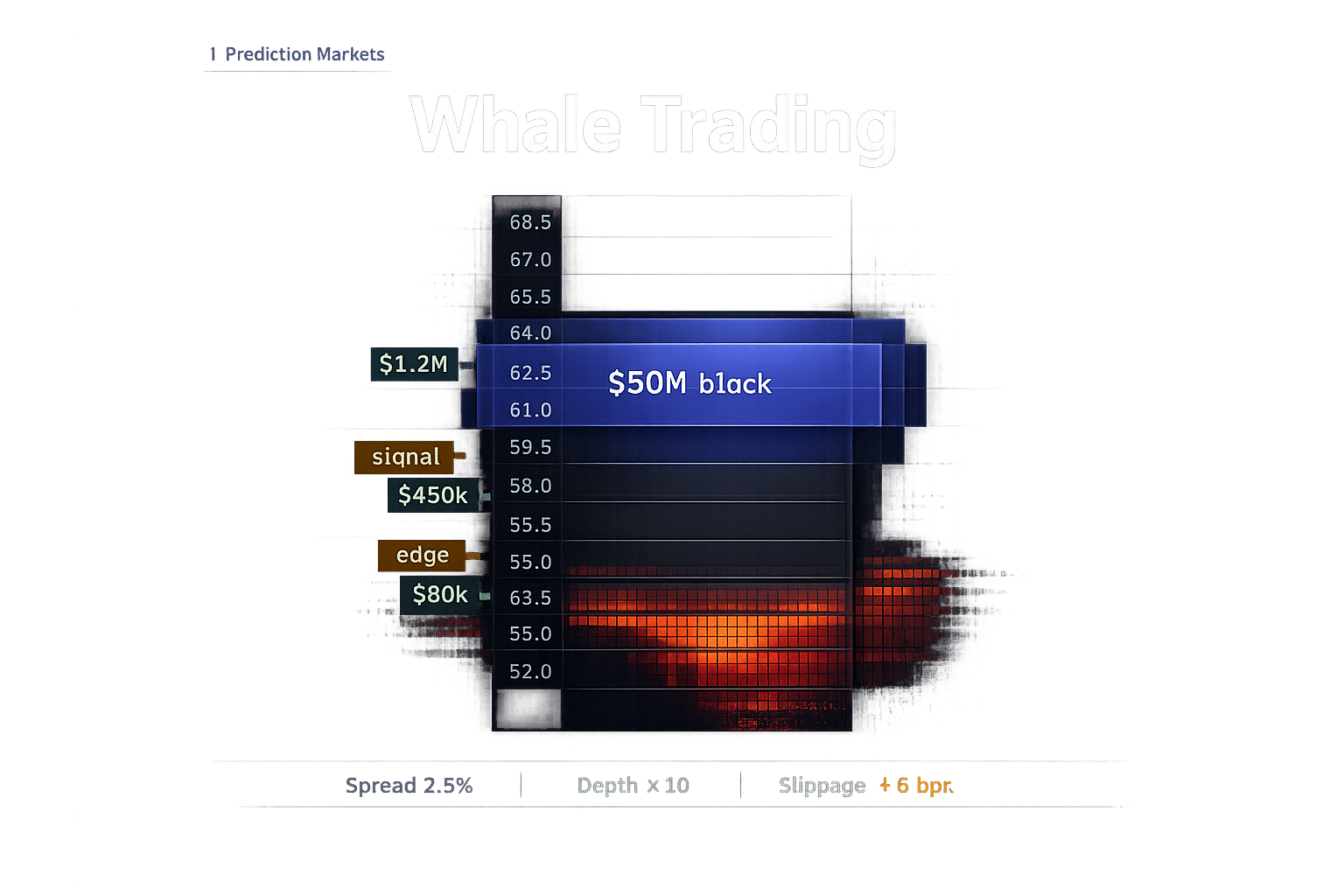
In prediction markets, whale trading refers to high-volume traders who control large sums of capital - typically $50,000 or more on a single outcome. These traders, often institutions or professionals, influence market dynamics significantly. A "mega-whale" exceeds $100,000 per position. Their trades can shift prices, drain liquidity, and signal privileged information. For example, a $217,000 trade in January 2026 moved a market from $0.32 to $0.47 in hours, yielding $148,000 in profit.
Whales leverage advanced tools, proprietary data, and disciplined strategies, often risking only 1–5% of their capital per trade. Their activity impacts smaller traders by creating price volatility, increasing slippage, and altering liquidity. Spotting whale activity involves watching for sudden price jumps, fragmented orders, or large trades during low-activity hours. Platforms like OpenMarkets provide tools to monitor and respond to these shifts in real time.
Key takeaways:
- Whales dominate 60% of prediction market liquidity.
- Large trades can move prices by 5–10 points in seconds.
- Retail traders should use limit orders, manage risk, and analyze whale patterns before acting.
Whale trading shapes prediction markets, offering opportunities and challenges for smaller participants.
How to Build Your Own Polymarket Whale Watcher Using Claude Code (No Experience)
sbb-itb-6d6afac
Understanding Whale Trading in Prediction Markets
Prediction Market Trader Tiers: From Fish to Mega-Whale
Who Are Whales in Prediction Markets?
In prediction markets, "whales" are traders who can significantly influence market movements by placing positions of $50,000 or more. Those with positions exceeding $100,000 are considered "mega-whales". These traders aren't your average participants - they include hedge funds, institutional players like Susquehanna International, former quantitative researchers, and highly skilled individual investors who treat these markets as serious financial tools.
What sets whales apart isn't just their capital but also their access to better information. They often rely on proprietary models, private polling, or direct sources of data - resources unavailable to most retail traders. This edge allows them to make more informed decisions and maximize the potential of market mechanisms. Whales also manage risk with precision, typically risking only 1–5% of their capital per trade. This disciplined approach helps them endure the inevitable rough patches that could wipe out smaller traders.
The influence of whales goes beyond their financial clout. A single large order can shift market prices dramatically, often before smaller traders even notice the change.
| Tier | Position Size | Who They Are |
|---|---|---|
| Fish | $1,000–$10,000 | Active retail traders; rely on news and social media |
| Shark | $10,000–$50,000 | Sophisticated retail traders; often domain experts |
| Whale | $50,000–$100,000 | Professional traders with informational advantages |
| Mega-whale | $100,000+ | Institutions, insiders, or high-confidence traders |
Understanding these tiers helps explain how whales exert such outsized influence on market dynamics.
How Prediction Markets Work
Prediction markets function by letting traders buy and sell shares tied to binary outcomes (yes-or-no questions). Shares are priced between $0.01 and $0.99, with the price reflecting the market's collective probability of an event occurring. For example, a share priced at $0.62 indicates a 62% probability that the event will happen.
Trades are executed through two mechanisms: order books, where bids and asks are matched, and Automated Market Makers (AMMs), which use algorithms to set prices. Unlike traditional sportsbooks that fix odds, prediction markets allow traders to adjust or exit their positions at any time before the event concludes. This setup encourages dynamic trading strategies like swing trading and mid-event adjustments.
Whale trades, however, can disrupt these systems. Large orders may drain liquidity from order books or skew AMM price curves, shifting the market's displayed probability by as much as 5–10 percentage points in seconds.
"Large trades do not just reflect a view. It creates a new reality... You are not just seeing what large traders think. You are seeing what they are doing to the market in real time." - 0xinsider Research
Examples of Whale Activity
Whales often use tactics like fragmented buying - splitting large positions into smaller orders (e.g., $500 increments) - to conceal their full intentions and avoid immediate price spikes. This strategy allows them to build positions without tipping off other traders.
One notable example occurred in April 2026, when a whale placed a $120,000 "No" position on a Hamas-Israel ceasefire market at $0.62 on April 14. Just two days later, after a major incident disrupted the ceasefire, the position's value skyrocketed, delivering a 244% return. The timing, size, and execution of this trade suggested either exceptional information or deep expertise.
Professional traders like Evan Semet highlight how institutionalized whale activity has become. Semet, a 26-year-old former quantitative researcher, left a traditional finance job after earning six figures monthly in prediction markets. He uses statistical models powered by AWS servers to guide his trades. According to Semet:
"There are certain accounts that miraculously have every single Google and OpenAI release date nailed perfectly, and it's like, all right, just don't fade those people." - Evan Semet, Professional Trader
These examples show that whale activity is calculated, well-resourced, and capable of moving markets before retail traders can react.
How Whale Trading Affects Markets
Price Impact and Slippage
When whales place large orders, they can shift market prices almost instantly. In thin prediction markets, for example, a $10,000 market buy can move the price by 10–20 points. In even smaller "Tier 3" niche markets, a $5,000 order might push the price by over 10 cents. This happens because the order consumes available liquidity, causing prices to adjust before the trade is fully executed.
This phenomenon, known as slippage, often leaves smaller traders at a disadvantage. When they enter the market shortly after a whale trade, they might find themselves paying higher prices than anticipated, without fully understanding why. The differences between market tiers highlight this effect:
| Market Tier | Example | Bid-Ask Spread | Capital Needed to Move Price |
|---|---|---|---|
| Tier 1 | Major elections | 1–3¢ | $50,000+ with minimal impact |
| Tier 3 | Niche events | 10–30¢ | As little as $5,000 |
In high-liquidity markets, whale trades might have a limited effect. But in thinner markets, even moderate-sized trades can trigger significant price swings, leaving retail traders vulnerable if they act too quickly after a whale's move. Beyond price shifts, these large trades can also destabilize market liquidity.
How Whales Affect Liquidity
Whale trades don't just move prices - they also alter market liquidity, making it harder for smaller traders to execute their orders efficiently. Although whales represent only about 10% of all trades, they account for 60% of the total dollar volume. This concentration of activity has mixed consequences for liquidity. While whales inject much-needed capital to keep markets moving, their trades can also degrade execution quality for everyone else.
Market makers, for instance, often react to suspected whale activity by widening bid-ask spreads or pulling their orders entirely to avoid losses. This response, known as adverse selection, increases trading costs for smaller participants. Retail traders who track whale activity sometimes exacerbate the situation by piling into the market after a whale trade, inadvertently pushing prices even further in the whale’s direction.
Information Signals and Manipulation Risk
Whale activity can also send signals - or create opportunities for manipulation - by influencing market sentiment. Large trades often act as public signals, even if the underlying reasoning remains private.
"A single $100,000 buy order in a thin market can move YES from 60¢ to 68¢. This price signal cascades to other participants, functioning as public information even when the original reasoning is private." - poly-sim.com Wiki
In some cases, whale trades made just before major news events suggest access to nonpublic information. Research indicates that fewer than 1% of wallets captured roughly 50% of all profits in key political markets between December 2025 and February 2026. Such profit concentration points to factors beyond mere chance.
Manipulation is another risk. In April 2026, 50 newly created wallets opened large "Yes" positions in a US-Israeli/Iran ceasefire market just before an announcement. One wallet turned $72,000 into $200,000 within hours. Retail traders who mistook this activity as a genuine signal unknowingly became exit liquidity for a coordinated move.
"A small minority moves the prices. A smaller minority keeps the money." - CoinDesk
How to Spot Whale Activity on OpenMarkets
Signs That a Whale Is Active
One way to recognize whale activity is through sudden, unexplained price movements. For instance, when a single trade causes a contract price to jump by 5–10 percentage points within seconds, it often signals rapid liquidity consumption. Another telltale sign is a spike in trading volume, especially during off-hours, like between 3 AM and 6 AM ET, when thinner order books are more vulnerable.
Timing can also offer clues. Take NBA markets in early 2026 as an example: the largest average trade sizes - about $13,557 per trade - were observed during the 3 PM ET pre-game window, while total trading volume hit its peak closer to 7 PM ET, right at tip-off.
Beyond these price and volume patterns, the way trades are executed can reveal even more about whale behavior.
Order Book and Trade Patterns to Watch
The structure of order flows often gives insight into whale activity. For example, whales using market orders signal urgency - they’re willing to accept slippage costs to secure their position quickly, often indicating time-sensitive information. On the other hand, more strategic traders prefer limit orders for over 60% of their trades, allowing them to build positions discreetly without drawing too much attention.
Keep an eye out for "iceberg orders." These are large trades hidden behind smaller, constantly replenished limit orders at a specific price level. Another pattern to monitor is "whale convergence", where multiple large wallets take similar positions within a two-hour window. Historically, this behavior has been a reliable predictor, with a 78% accuracy rate in forecasting outcomes.
"A large trade does not just reflect a view. It creates a new reality." - 0xinsider
These patterns set the stage for leveraging OpenMarkets' tools to track whale activity in real time.
Using OpenMarkets for Real-Time Detection
OpenMarkets simplifies monitoring whale activity by integrating data from sportsbooks, exchanges, and prediction markets into a single platform. With its real-time trade data streams, you can spot large trades as they happen, while the market depth tools help identify order book walls before they significantly impact pricing.
Speed is essential here. Even a slight delay in execution could mean missing an optimal entry point, as a whale trade might shift the market by 15 cents or more. By pairing live trade data with the News API - which includes feeds like Bloomberg - you can quickly determine whether a whale's activity is based on meaningful information or routine rebalancing.
Strategies for Smaller Traders in Whale-Driven Markets
Managing Order Size and Placement
In markets influenced by whale trades, smaller traders need to be strategic about how they place and size their orders. One common pitfall is over-reliance on market orders. When a whale sweeps through the order book, the resulting price shifts can significantly widen the spread and increase slippage costs. For instance, low-liquidity contracts might see round-trip costs spike to as much as 30% on a $0.50 contract, compared to a more manageable 2–4% in high-liquidity markets like major elections or top-tier sports.
To navigate this, consider using limit orders at your estimated fair value. Breaking large positions into smaller chunks using a Time-Weighted Average Price (TWAP) strategy can help reduce your market impact and avoid signaling your intentions. A good rule of thumb is to limit your total position in a thin market to no more than 10% of the contract's average daily volume (multiplied by the number of days until the market resolves). Additionally, avoid allocating more than 5% of your overall capital to a single low-liquidity contract.
When to Follow or Avoid Whale Moves
Not every large trade is worth mimicking. The key is distinguishing between trades driven by valuable information and those that are purely mechanical. For example, when a whale takes a concentrated position in a single market - often referred to as "convicted size" - it typically signals a higher level of confidence than spreading smaller bets across multiple markets.
"A trader does not risk $100,000 on a single outcome without having done substantial research, possessing unique information, or having high confidence in their probability estimate." - 0xinsider
Before deciding to follow, review the whale's trading history. Wallets with a proven win rate above 60% are worth monitoring, while anonymous "burner wallets" with no track record should be approached cautiously. Also, keep an eye out for contrarian signals. For instance, if a whale buys "NO" at $0.15 in a market where 85% are betting "YES", it may indicate a deeper conviction than simply following the crowd. Historically, positions held for one hour to one day have performed best, boasting a 62.9% win rate and an average profit of +$256,691. In contrast, trades held for less than an hour tend to fare poorly, with only a 26.2% win rate.
"The value of large trade data decays exponentially with time. A large buy at $0.35 is actionable at $0.38 (minutes later), interesting at $0.42 (hours later), and historical at $0.47 (a day later)." - 0xinsider
These insights can help you decide when to act - or hold back - based on whale activity.
Using OpenMarkets to Stay Competitive
OpenMarkets provides smaller traders with tools to stay agile in whale-driven markets. By consolidating data from sportsbooks, exchanges, and prediction markets, the platform helps you spot cross-platform mispricings. For example, a whale’s move in a prediction market might briefly lag behind sportsbook lines, creating a short-lived arbitrage opportunity. With its rapid execution capabilities, OpenMarkets enables you to capitalize on these gaps quickly.
It also supports effective hedging. If a whale's trade drives the market against your position, OpenMarkets can help you identify correlated markets for partial hedges, limiting potential losses. To stay ready for these opportunities, it's wise to keep at least 20% of your capital in cash or stablecoins. This ensures you can act swiftly when the right moment arises.
How Platforms and Liquidity Providers Handle Whale Risk
Market Design Safeguards
Whale trades, due to their sheer size, can disrupt market dynamics, but platforms have tools in place to maintain stability. One key approach is automated resolution, where markets settle based on official, verifiable data - like government reports or sports scores - eliminating the risk of manipulation by high-volume traders.
Another protective measure is on-chain transparency. For instance, every trade on Polymarket is recorded on the public Polygon blockchain. This means that whale trades, their position sizes, and historical win rates are fully visible to market participants. Additionally, forensic systems are in place to flag unusual patterns, such as large trades from new wallets just before major announcements.
These safeguards create the foundation for how liquidity providers manage the risks associated with whales.
How Liquidity Providers Manage Risk
Once platform safeguards are in place, liquidity providers step in with their own strategies to handle the challenges posed by large trades. When a whale places a significant order, liquidity providers face two main risks: adverse selection risk (the chance that the whale has better information) and inventory risk (the danger of holding an unbalanced position).
To counter adverse selection risk, market makers often widen bid-ask spreads.
"The spread represents the round-trip cost of entering and immediately exiting a position." - NexusFi Academy
For inventory risk, market makers adjust their quotes. For example, if they've sold too many "YES" shares, they may raise the ask price to deter more buyers while lowering the bid price to attract sellers. This allows them to gradually rebalance their position without increasing their exposure in one direction. Large institutional firms, like Susquehanna International, also play a role by providing the capital depth needed to handle whale trades without causing extreme price movements.
OpenMarkets' Role in Risk Management
OpenMarkets adds another layer of stability by offering real-time visibility across nine platforms. By monitoring capital distribution across venues, OpenMarkets can identify market shifts earlier than most. Its consolidated feed highlights significant positions as they happen, often before other platforms adjust their prices.
"The traders who consistently profit on prediction markets are faster. They see the $200K buy before it moves the price, and they act on it while the rest of the market is still sleeping." - 0xinsider
This cross-platform view also helps detect coordinated whale activity. For example, when three or more unrelated large wallets enter the same position within a two-hour window, research shows a 78% accuracy in predicting outcomes based on specific datasets. OpenMarkets' feed makes these patterns visible in real time, giving market participants valuable insights into whale behavior and its potential impact.
Conclusion: Key Takeaways on Whale Trading
Whale trading plays a pivotal role in shaping prediction market dynamics. A small group of large traders wields significant influence over market liquidity. Their trades don’t just reflect their market outlook - they actively shift prices in real time, often ahead of the broader market's response.
One crucial takeaway is the difference between following and copying. Observing whale activity can provide valuable insights to guide your analysis, but blindly mimicking their trades is not a sound strategy. For retail traders aiming to build strong approaches, this distinction is essential.
Context matters just as much as trade size. For instance, a $50,000 trade in a smaller, niche market carries far more weight than the same amount in a $20 million market. Additionally, when multiple whales independently align on one side of a market within a short time frame - a phenomenon known as whale convergence - backtested data shows this has led to accurate outcomes 78% of the time. This highlights how whale trading impacts liquidity and pricing, making careful analysis a necessity.
"A large trade does not just reflect a view. It creates a new reality." - 0xinsider Research
FAQs
Are whale trades always “smart money” signals?
Large trades, often referred to as "whale trades", don't always mean you're looking at "smart money" in action. Sure, they can reflect strong confidence or deeper research, but that's not the whole story. These trades might also stem from reasons like hedging strategies, managing cash flow, or adjusting inventory - none of which necessarily signal insider knowledge. And even the most informed traders aren't immune to errors. So, while these trades can provide useful context, they shouldn't be treated as foolproof indicators. Use them to complement your analysis, not replace it.
How can I avoid getting hurt by slippage after a whale move?
When a whale makes a big move, it can cause prices to shift significantly by eating up the depth of the order book. Jumping in right after such trades can be risky, as you may end up buying or selling at inflated prices.
To navigate this, it's crucial to evaluate the market's liquidity compared to the size of the trade. In markets with less depth, larger trades tend to create more price slippage. A smart approach is to gradually scale into your positions, which helps minimize the impact on prices as you execute your trades.
How do I tell real whale activity from manipulation?
When trying to tell genuine whale activity apart from manipulation, context is everything.
- Look at trade size: A big trade in a low-volume market carries much more weight compared to the same trade in a high-volume market.
- Check trader history: Consistent patterns or a history of high win rates can reveal a lot about a trader's intentions.
- Pay attention to timing: Trades that happen around major events or when several whales align on the same position often reflect real conviction rather than an attempt to manipulate.
Understanding these factors can help you make better sense of the market's movements.
Ready to trade your first market on Polymarket?
Put this into practice. Polymarket is the world’s largest prediction market platform enabling users to trade on the outcomes of future events across diverse topics. Polymarket lets you trade real-money contracts on real-world outcomes, and getting set up takes only a few minutes.
→ Open your Polymarket account
Disclosure: OpenMarkets may earn a referral commission if you sign up through this link, at no extra cost to you. Event trading carries risk — only trade what you can afford to lose.