Sportsbook vs. Prediction Market: Key Differences Explained
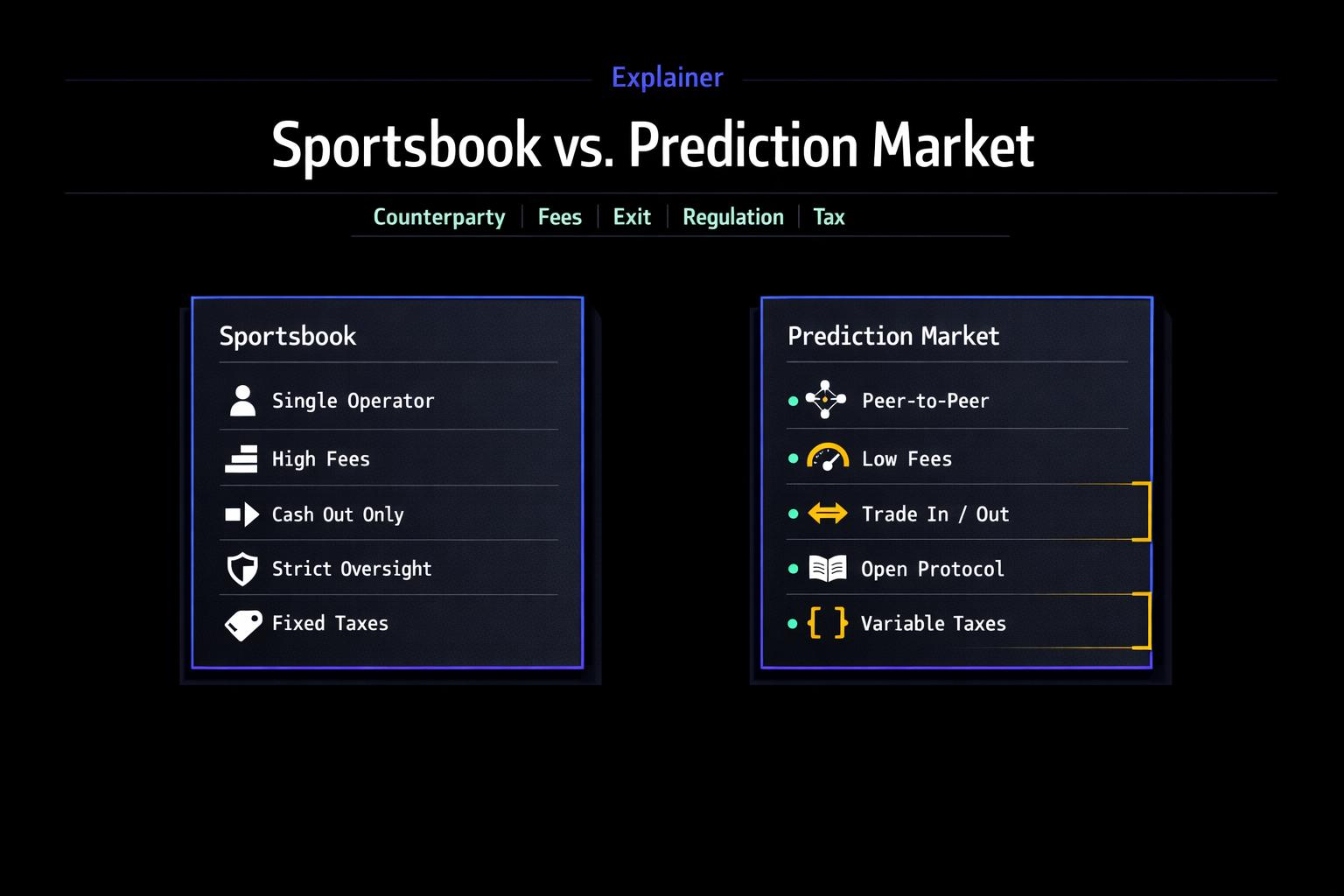
If you're deciding between a sportsbook and a prediction market, here's the bottom line: sportsbooks are house-run betting platforms focused on sports, while prediction markets are peer-to-peer exchanges where traders speculate on a wide range of outcomes, including politics and economics. Each operates differently, offers unique features, and suits different types of users.
- Sportsbooks: You bet directly against the house. Odds are set by the operator, with a built-in profit margin (the "vig"). They cater to casual bettors, offering a variety of sports-focused markets like moneylines, spreads, and parlays. However, successful bettors may face limits on their accounts.
- Prediction Markets: These are peer-to-peer platforms where users trade contracts based on event probabilities. Prices reflect market-driven probabilities, and you can sell your position at any time. These markets cover broader topics, such as elections and economic trends, and often have lower fees.
Quick Comparison:
| Feature | Sportsbook | Prediction Market |
|---|---|---|
| Counterparty | House (operator) | Other traders (peer-to-peer) |
| Odds/Prices | Set by operator, includes vig | Market-driven probabilities |
| Fees | 4.5–5% (embedded in odds) | 1–4% (separate transaction fees) |
| Market Scope | Sports-focused | Broader topics, including politics and economics |
| Flexibility | Limited exit options | Sell positions anytime |
| Tax Treatment | Gambling income | Potential capital gains rates |
| Regulation | State-level gaming laws | Federal oversight (CFTC) |
Key Takeaway: Sportsbooks are ideal for casual sports bettors, while prediction markets are better for traders seeking flexibility, lower fees, and broader event coverage.
Sportsbook vs. Prediction Market: Side-by-Side Comparison
The Sportsbook Model
How Sportsbooks Set Odds and Manage Risk
Sportsbooks operate on a finely tuned model that revolves around managing risk for every bet placed. To set their opening lines, analysts rely on a mix of historical data, injury updates, weather conditions, and market trends. These lines include a built-in margin, often referred to as the "vig" or "juice." As bets come in, particularly from sharp bettors who often reveal true probabilities, sportsbooks adjust these lines in real time to balance their risk exposure.
Take a standard NFL point spread as an example: both sides are typically priced at –110, meaning you’d wager $110 to win $100. This pricing implies a total probability of about 104.8%, with the extra 4.8% representing the sportsbook’s margin.
To further manage their liability, sportsbooks often cap how much consistently winning bettors can wager. In regulated U.S. markets, sportsbooks generally maintain a hold of 4.5–5% on standard bets, while margins on futures and more niche or exotic prop bets can soar to 15–20% or higher.
These strategies are essential for balancing risk and shaping the types of bets and markets sportsbooks prioritize.
Bet Types and Market Scope
Sportsbooks cover a wide array of sports, from major U.S. leagues like the NFL, NBA, MLB, and NHL to college sports, soccer, MMA, and beyond. A single NFL or Premier League game alone might offer over 200 distinct betting markets. Here’s a breakdown of the main bet types and how they work:
| Bet Type | How It Works | Typical Vig/Hold |
|---|---|---|
| Moneyline | Bet on the outright winner of the game | 6–15% |
| Point Spread | Wager on the margin of victory | 4–5% |
| Total (Over/Under) | Bet on the combined score of both teams | 4–5% |
| Player Props | Bet on individual stats (e.g., passing yards, goals) | 15–20%+ |
| Parlays / SGPs | Combine multiple outcomes for a higher payout | 15–20%+ |
| Futures | Place long-term bets (e.g., who will win the Super Bowl) | 15–20%+ |
Markets with higher margins, like player props or parlays, often appeal to casual bettors seeking bigger payouts. These higher-margin bets also allow sportsbooks to diversify their offerings while maintaining profitability.
User Experience in Sportsbooks
The heart of any sportsbook interface is the bet slip. This tool lets you select an outcome, enter your wager, and instantly see your potential payout. Mobile platforms make the process even smoother, allowing for quick bets and real-time updates.
Once an event concludes, sportsbooks settle bets within minutes. Many also offer a cash-out feature, which lets you close out your bet before the game ends. While convenient, cash-out options come with marked-up prices, meaning you often accept less favorable terms.
However, there’s a catch for highly successful bettors. If you consistently win, sportsbooks may gradually reduce your betting limits - a well-known frustration among seasoned gamblers.
"The bettor pays for the Super Bowl commercial through worse odds." - AgentBets.ai
This quote highlights the trade-offs in sportsbook operations, where promotional efforts and flashy features are often offset by less favorable odds for users.
sbb-itb-6d6afac
The Prediction Market Model
How Prices Form in Prediction Markets
In prediction markets, odds are shaped entirely through trading activity using a Central Limit Order Book (CLOB) - a system similar to the one employed by the NYSE. As traders grow more confident about a particular outcome, demand for the corresponding contract increases, pushing its price higher. Conversely, when sentiment shifts, sellers drive the price down.
This process, called price discovery, is a stark contrast to how sportsbooks set odds. Here, contract prices directly represent market-driven probabilities. For example, a contract priced at $0.65 reflects the collective judgment of traders, suggesting a 65% likelihood of that outcome. Unlike sportsbooks, which typically embed a margin of 4.5%–5% into their odds, prediction markets charge separate transaction fees, usually between 1% and 2%.
"The price is not set by an algorithm or a centralized forecaster. It emerges from the aggregate behavior of thousands of traders, each bringing their own information, research, and conviction." - Decentralised News
A compelling example of this market-driven accuracy occurred during the 2024 U.S. Presidential Election. While polling aggregates indicated a near tie, Polymarket's pricing consistently showed an implied probability of over 60% for the eventual winner in the weeks leading up to Election Day. In the end, the market's pricing turned out to be more accurate than the polls.
This dynamic price-setting system forms the backbone for the different contract types discussed below.
Contract Types and Market Scope
The binary contract is the most common format in prediction markets. It’s a simple Yes/No proposition where the contract pays $1.00 if the event occurs and $0.00 if it doesn’t. For example, a question like, "Will the Kansas City Chiefs win Super Bowl LX?" would fall under this category.
In addition to binary contracts, there are multi-outcome markets that cover scenarios with several possible results. These could include questions like which team will win a division or which interest rate range the Federal Reserve will choose. In such markets, the prices of all possible outcomes typically add up to $1.00, ensuring consistency.
Unlike traditional sportsbooks, which primarily focus on sports, prediction markets span a much broader range of topics. These include elections, economic trends, geopolitical events, and even entertainment awards. While sports contracts remain a substantial part of the trading volume, the industry as a whole processed over $44 billion in total trading volume across 2025. This wide variety highlights the versatility of prediction markets beyond just sports betting.
Trading Positions and Realizing Profit
One key advantage of prediction markets is the ability to exit a position before the event is resolved. This flexibility, combined with different contract formats, gives traders an edge. For instance, if you buy a contract at $0.40 and its price rises to $0.70 based on new developments, you can sell it at $0.70, locking in a $0.30 profit without waiting for the event to conclude.
Liquidity plays a vital role in these markets. In high-volume markets, narrow bid-ask spreads allow for smooth execution of large trades. On the other hand, thinner markets may experience wider spreads and slippage. Each contract also comes with pre-defined resolution criteria, ensuring clarity when determining outcomes. For example, weather contracts may rely on NOAA data, while interest rate markets might use official FOMC statements.
Sportsbook vs. Prediction Market: Direct Comparisons
Structure and Pricing Differences
The main distinction lies in the counterparty: sportsbooks pit you against the house, while prediction markets connect you with other traders. This setup impacts how pricing works and what exit options are available. Sportsbooks use American odds (e.g., -110, +200) and include their profit margin - known as the vig - directly in those odds, typically ranging from 4.5% to 5%. In contrast, prediction markets use a binary pricing scale between $0.01 and $0.99, where the price reflects the implied probability. For instance, a contract priced at $0.65 indicates a 65% likelihood of that outcome.
"The house-vs-peer distinction isn't academic. It shapes pricing, exit options, regulation, and taxes." - Jeff Edelstein, InGame
When you place a bet with a sportsbook, it’s usually locked in unless you use a cash-out option, though these are often priced 10–20% below fair market value. Prediction markets, on the other hand, allow you to sell your position at any time at the current market price, offering much more flexibility. These pricing models not only define the market structure but also influence how users interact with each platform.
| Feature | Sportsbook | Prediction Market |
|---|---|---|
| Counterparty | The house (operator) | Other traders (peer-to-peer) |
| Price Format | American Odds (-110, +150) | Binary Contracts ($0.01–$0.99) |
| Revenue Model | Embedded vig/margin | Transaction or settlement fees |
| Exit Strategy | Limited (controlled by operator) | Open (sell anytime at market price) |
| Account Limits | Often imposed on winning bettors | Rare or nonexistent |
User Behavior and Use Cases
These structural and pricing differences shape the way users engage. Sportsbooks are geared toward casual fans - those who want to make a game more exciting. The interface prioritizes simplicity, offering bet slips, parlays, and promotional bonuses. The process is straightforward: pick a side, place your bet, and wait for the result.
Prediction markets, in contrast, attract users who approach events analytically, treating them as probabilities. Their platforms resemble stock trading interfaces, complete with order books and price charts instead of traditional bet slips. A standout feature is the ability to exit positions early, enabling traders to capitalize on price movements instead of waiting for the final outcome.
Market depth also sets these platforms apart. Sportsbooks can offer over 250 markets for a single Premier League match, covering everything from first goalscorers to the number of corner kicks. Prediction markets, however, typically focus on just one contract for the match result. This makes sportsbooks better for in-game props and complex bets, while prediction markets shine for long-term positions where early exits are advantageous.
Next, let’s explore how regulations and legal frameworks further distinguish these platforms.
Risk, Regulation, and Legal Framework
Regulatory environments play a major role in shaping how these platforms operate. Sportsbooks are regulated by state gaming commissions. By 2026, sports betting is expected to be legal in 39 states plus Washington, D.C., with operators required to follow state-specific rules, including licensing and age restrictions (usually 21+).
Prediction markets, on the other hand, fall under federal oversight, often regulated by the Commodity Futures Trading Commission (CFTC) as derivatives exchanges. This allows them to operate nationwide, bypassing state gambling laws. Federal rules also set the minimum age at 18. This state-versus-federal divide has sparked debates about whether event contracts in prediction markets are gambling disguised as financial products.
"Event contracts on regulated exchanges are not gambling; they are derivatives that allow Americans to hedge real economic risk." - Caroline Pham, CFTC Chair
"Sports event contracts are sports betting wearing a derivatives costume." - Bill Pascrell III, Partner, Princeton Public Affairs Group
Tax treatment also varies significantly. Sportsbook winnings are taxed as ordinary gambling income, with federal rates reaching up to 37%. Prediction market gains, however, may qualify for Section 1256 treatment, which splits taxation into 60% long-term and 40% short-term capital gains, resulting in a maximum effective federal rate of about 26.8%. That said, the tax rules for prediction markets remain a topic of ongoing discussion.
| Dimension | Sportsbook | Prediction Market |
|---|---|---|
| Regulator | State gaming commissions | Federal CFTC |
| Legal Availability | 39 states + D.C. (as of 2026) | Nationwide (under federal rules) |
| Minimum Age | 21+ (most states) | 18+ (federal derivatives) |
| Tax Treatment | Ordinary gambling income | Section 1256 (capital gains split) |
| Compliance | State-specific licensing | Single federal registration |
Choosing the Right Model for Your Needs
Factors to Consider
When deciding between a sportsbook and a prediction market, it’s important to weigh how each platform aligns with your goals. Sportsbooks cater to casual bettors and those drawn to bonuses, while prediction markets appeal to users seeking analytical tools and flexibility across a range of events.
- Account limits: Sportsbooks often impose limits on successful bettors to protect their margins. Prediction markets, on the other hand, rely on transparent transaction fees instead of restricting users.
- Cost: Sportsbooks typically charge a vig of 4.5%–5%, while prediction markets operate with lower fees, usually around 1%–2%.
- Geography: As of May 2026, online sports betting is legal in 38 states and D.C. However, CFTC-regulated prediction markets are accessible in approximately 48 states, including California and Texas, where sportsbooks may face restrictions.
- Tax treatment: Sportsbook winnings are taxed as ordinary income. Meanwhile, gains from prediction markets may qualify for capital gains rates under Section 1256, offering potential tax advantages.
| Use Case | Optimal Platform | Why |
|---|---|---|
| Daily sports/parlays | Sportsbook | Extensive market variety and strong parlay options |
| Politics/economics | Prediction Market | The only legal U.S. venue for these categories |
| Large stakes ($5,000+) | Prediction Market | No wagering limits and transparent order books |
| Live/in-play betting | Sportsbook | Faster access to over 200 live markets per game |
| Tax efficiency | Prediction Market | Potential for better tax treatment under Section 1256 |
These differences highlight the value of platforms that combine elements of both systems.
How OpenMarkets Bridges the Gap
For advanced users, combining the strengths of both models can be a game-changer. OpenMarkets acts as a unified infrastructure platform, linking sportsbooks, exchanges, prediction markets, and peer-to-peer platforms. By detecting pricing discrepancies in real time, it allows traders and developers to execute cross-platform trades almost instantly. This capability captures opportunities that would otherwise be missed with manual monitoring.
Key Takeaways
Sportsbooks and prediction markets serve distinct purposes. Sportsbooks are ideal for a straightforward, sports-focused betting experience with enticing promotions and a wide range of options. Prediction markets, however, provide lower fees, broader coverage - including non-sports events - and freedom from account restrictions. Your choice will depend on your goals, trading preferences, and location.
For those who want the best of both worlds, platforms like OpenMarkets simplify the process. They eliminate the hassle of managing multiple accounts, tracking odds across platforms, and manually executing trades, making it easier to capitalize on opportunities wherever they arise.
Prediction Markets vs Sportsbooks
FAQs
How do I convert a prediction market price into a probability?
In a prediction market, the price of a contract shows its implied probability. Here's how it works: each contract pays $1.00 if the event happens and $0.00 if it doesn't. You can interpret the price in cents as a percentage. For instance, if a contract is priced at $0.65, it reflects a 65% probability of the event occurring, based on the collective judgment of market participants.
When is a sportsbook cash-out a bad deal?
A sportsbook cash-out becomes a poor choice when the offer significantly undervalues your bet's fair market worth. Typically, these offers come with a hefty 10%-30% discount (or even more), as sportsbooks prioritize locking in their profits while minimizing their risk. If you consistently take these deals, it can chip away at your long-term potential gains. Essentially, you’re trading away the higher expected value of your bet for the comfort of immediate certainty - often at a steep cost.
What should I look for to avoid slippage in prediction markets?
To minimize slippage in prediction markets, always review the order book depth before executing a trade. Slippage occurs when there isn't sufficient liquidity at your desired price, forcing your order to be filled at less favorable rates. If your trade impacts the market price by more than 2 cents, it may be wise to lower the order size or break it into smaller chunks to achieve a more favorable average price.
Ready to trade your first market on Polymarket?
Put this into practice. Polymarket is the world’s largest prediction market platform enabling users to trade on the outcomes of future events across diverse topics. Polymarket lets you trade real-money contracts on real-world outcomes, and getting set up takes only a few minutes.
→ Open your Polymarket account
Disclosure: OpenMarkets may earn a referral commission if you sign up through this link, at no extra cost to you. Event trading carries risk — only trade what you can afford to lose.