Kalshi Review 2026 Prediction Market: Trade on Anything
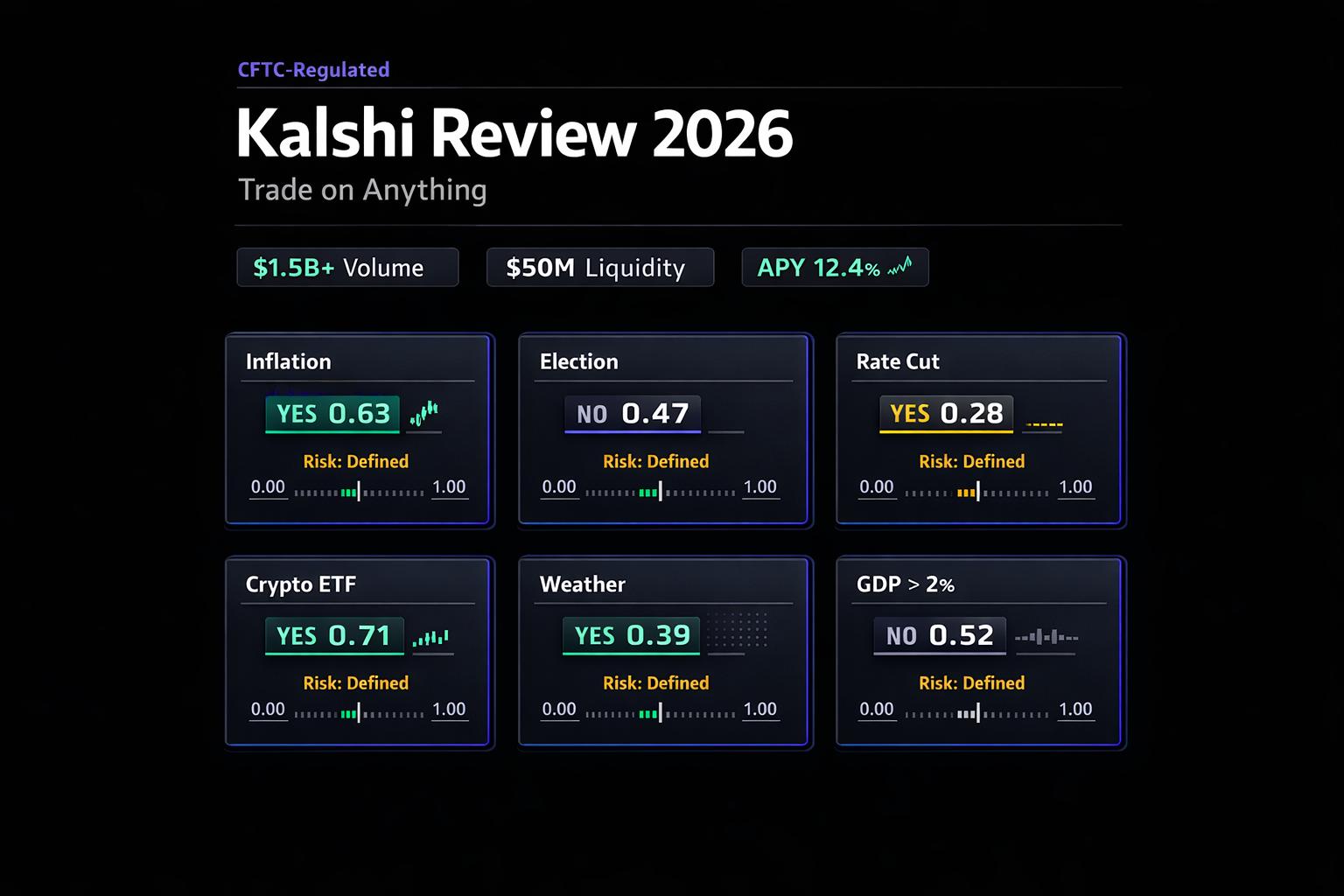
Kalshi has become a dominant player in the U.S. prediction markets by 2026, capturing 66% market share and processing over $14.8 billion in trading volume in April alone. It allows users to trade on the outcomes of real-world events - like elections, economic shifts, and sports - using binary contracts priced between $0.01 and $0.99. Regulated by the CFTC, Kalshi ensures legal compliance across all 50 states, offering a transparent and secure platform for traders.
Key Highlights:
- Market Variety: Trade on politics, economics, sports, technology, weather, and more.
- Ease of Use: Simple account setup with KYC verification, intuitive web and mobile platforms.
- Fees: Maker fees are lower than taker fees, but costs can add up for contracts priced near $0.50.
- Regulation: Fully regulated by the Commodity Futures Trading Commission (CFTC), ensuring compliance and security.
- Earnings: Earn 3.75–4.05% APY on idle balances.
Kalshi is ideal for U.S.-based users seeking a regulated, fiat-native prediction market, but high-frequency traders and those in restricted states may face limitations.
How Kalshi Works: Trading on Events
Step-by-Step Guide to Trading on Kalshi
Getting started with Kalshi is simple. First, create an account using your email, Google, or Apple login. Then, complete the required KYC (Know Your Customer) verification. For Tier 2 access, which offers higher deposit and withdrawal limits, you'll need to provide your Social Security Number, a government-issued ID, and a live selfie. It's a good idea to complete this step right away, as Tier 1 verification comes with stricter limits.
Once verified, you can fund your account in USD. ACH transfers are free but take 1–3 business days to process. For instant deposits, you can use a debit card, though there’s a ~2% processing fee. Wire transfers are another option, and while Kalshi doesn’t charge for them, they generally allow for larger deposit amounts.
Next, you can explore the platform’s markets. Use category filters or check out the "Trending" and "Breaking" tabs to find high-volume or newly listed markets. When you’re ready to trade, you have two options: Market Orders for immediate execution or Limit Orders to set a specific price. Experienced traders often prefer limit orders to avoid price slippage and benefit from lower maker fees ($0.44 per 100 contracts compared to $1.75 for takers).
Before placing a trade, review the "Resolution Rules" in the Market Details section. These rules specify the official data source that Kalshi will use to determine the outcome. For example, inflation markets rely on the Bureau of Labor Statistics (BLS), while weather markets use NOAA data. This ensures there’s no confusion about how a market will settle.
"Kalshi is the most established regulated prediction market in the US, with a massive catalog of markets, a clean mobile app, and strong consumer protections." - Marcus Ellroy, Editorial Manager, PredictGeek
Once your trades are in, understanding how event contracts settle will help you better gauge your potential returns.
How Event Contracts Work
Kalshi’s event contracts revolve around straightforward Yes/No questions about future real-world events. The price of each contract, which ranges from $0.01 to $0.99, reflects the market’s collective estimate of the event's likelihood.
For example, if the "Yes" side of a contract is trading at $0.60, the "No" side will trade at approximately $0.40. Traders can use this pricing relationship to identify opportunities, such as buying the less expensive side if they believe the market has misjudged the odds. When the event concludes, Kalshi uses its predefined data source to settle contracts: winning contracts pay out $1.00, while losing ones are worth $0.00.
Here’s an example: In November 2024, a Fed rate cut "Yes" contract was priced at $0.78 on Kalshi, while the CME FedWatch tool suggested an 86% probability. A trader who purchased 50 contracts at $0.78 (spending $39.00) earned a 28.2% return when the Fed cut rates on December 18, 2024, and the contracts settled at $1.00.
You’re not locked into your position, though. You can sell your contracts at any time before settlement to secure profits or limit losses. This flexibility, combined with the fact that your maximum loss is capped at what you paid, makes event contracts easier to understand than many traditional financial instruments.
"Your maximum loss is known upfront - you lose what you paid. No margin call, no additional fees on the loss." - PredScope
sbb-itb-6d6afac
Market Categories on Kalshi
Main Market Categories
Kalshi offers a wide array of trading opportunities. As of early 2026, the platform features over 100 active markets at any given time. These markets cover everything from federal interest rate changes to the outcomes of major sports events. This variety is a major draw - it ensures there's something for traders with expertise in almost any field.
| Market Category | Tradable Events |
|---|---|
| Politics | Elections, congressional control, international races |
| Economics | Fed rate decisions, CPI inflation, GDP growth, unemployment |
| Sports | NBA, NHL, MLB, tennis, MMA outcomes |
| Technology & AI | Top-ranked AI models, Tesla deliveries, IPO announcements |
| Crypto | Bitcoin and Ethereum price milestones |
| Climate & Weather | Hurricane landfalls, record temperatures, rainfall probability |
| Culture | Award show winners, box office results, art auction records |
| Mention Markets | Speculation on specific words or phrases in prominent speeches |
Sports and macroeconomic markets dominate the platform, making up about 90% of the total trading volume. However, smaller categories are gaining traction. For example, Kalshi introduced "Mention Markets" in 2025, allowing users to trade on whether specific words or phrases will appear in speeches or statements.
"The mention markets are particularly distinctive, contracts on whether specific words or phrases will appear in speeches, press conferences, or Federal Reserve statements." - iPredicta
This diversity of categories creates a dynamic trading environment, with real-world outcomes driving significant activity. Below are examples of how these markets operate in practice.
Examples of Events You Can Trade On
On May 26, 2026, Kalshi hosted a market for the Texas Republican Senate Runoff, where traders speculated on Paxton's victory margin. This market alone saw $1,838,912 in trading volume, with Paxton trading as a 38% favorite in the 10–15% margin bracket.
Sports markets are especially active. By May 2026, the Pro Basketball (M) category had reached an enormous $1,525,326,725 in total volume. A Game 5 matchup between San Antonio and Oklahoma City generated $6,211,684 in volume, with Oklahoma City favored at a 1.60x payout.
Technology markets are also growing. A May 2026 market asking "Which companies will have a top-ranked AI model this year?" attracted $971,304 in volume, with OpenAI priced at 1.82x and xAI at 4.17x. Meanwhile, in economics, a market on the "Number of rate cuts in 2026" saw $3,906,834 in volume, with "Exactly 0 cuts" as the leading option.
Even cultural events find their place on Kalshi. After Jackson Pollock's Number 7A, 1948 sold for $181.2 million at Christie's on May 18, 2026, Kalshi launched a market for the "Most expensive auction work sold in 2026." With strike prices set above $250M and $300M, this market saw $23,208 in volume - a smaller figure but still a testament to the platform's broad scope.
For traders looking to explore these opportunities, OpenMarkets is the go-to tool, providing a centralized hub for the best trading lines across politics, sports, economics, and more.
Platform Features and Tools
Trading Interface and Mobile App
Kalshi's web platform offers a sleek dashboard that keeps everything you need front and center - open positions, order history, and account balance. Each market page comes equipped with a real-time order book, historical price charts (ranging from 1-hour snapshots to all-time views), and TradingView integration for deeper analysis. The desktop version is ideal for digging into the details, whether you're analyzing order book depth, reviewing price trends, or managing complex, multi-position strategies.
For on-the-go traders, the iOS and Android apps pack most of the desktop features into a mobile-friendly experience. These apps include biometric authentication, swipe-to-trade gestures, a home screen widget displaying portfolio value and daily P&L, and customizable push notifications. The apps have earned high praise, with 4.7/5 stars from over 22,000 reviews on the App Store and 4.5/5 from 3,000+ reviews on Google Play. A smart strategy? Use the desktop for research-heavy tasks, then switch to mobile for quick monitoring and trade execution. This seamless integration ensures that Kalshi's platform remains accessible and efficient, no matter where you are.
"The mobile app is excellent for monitoring positions and placing standard trades, but has a few limitations compared to the web." - PredScope
Liquidity and Pricing Mechanics
Kalshi doesn't just stop at user-friendly design - it also delivers on liquidity and pricing, making trading smoother and more efficient. The platform uses a Central Limit Order Book, which allows users to trade directly with one another. Contract prices align closely with market probabilities, and in high-volume markets, bid-ask spreads often drop below $0.03. In March 2026, Kalshi hit a milestone, processing a staggering $12.35 billion in trading volume.
For those looking to optimize their trades, market orders provide instant execution, while limit orders help reduce slippage and cut down on fees. On top of that, Kalshi offers an added perk: traders can earn 3.75–4.05% APY on idle balances while waiting for the right opportunities.
"If you are only ever placing market orders, you are starting every trade in a hole." - Aries Mike
This APY on unallocated funds might seem small at first glance, but over time, it adds up, giving traders an extra edge. For up-to-the-minute updates and some of the sharpest insights in the prediction market space, check out OpenMarkets.
Trading Strategies and Risk Management
Strategies for Trading on Prediction Markets
Achieving success on Kalshi hinges on finding your edge. Your edge is the gap between your estimated probability of an event and the market's implied probability. For instance, if you believe there's a 75% chance of an event happening, but the contract is priced at $0.60 (implying a 60% probability), that 15% difference is your edge.
Once you've identified an edge, the next step is position sizing. Many experienced traders rely on the Kelly Criterion to determine the optimal bet size. However, most use a Fractional Kelly approach, risking only 25%–50% of the calculated amount to reduce volatility. A good rule of thumb is to avoid risking more than 5%–15% of your total bankroll on any single contract.
Focusing on one or two market categories can help refine your edge. Specialization lets you develop a deeper understanding of how Kalshi prices outcomes compared to public data. A balanced portfolio often includes 4–8 uncorrelated positions, which helps ensure that a single bad trade doesn't derail your overall performance.
"The traders who win on Kalshi long-term aren't necessarily smarter - they're more systematic." - Prevayo Blog
No strategy is complete without disciplined risk management.
Managing Risk in Event Trading
Even with a strong trading edge, managing risk is essential for sustained success on Kalshi. Each contract resolves to either $1.00 (Yes) or $0.00 (No), meaning that a position can lose its entire value if the outcome doesn't go your way. To navigate these risks effectively, it's vital to understand and mitigate them.
Here's a breakdown of common risk factors and how to address them:
| Risk Factor | What It Means | How to Manage It |
|---|---|---|
| Event Uncertainty | Outcomes are inherently unpredictable. | Use the Kelly Criterion to size positions carefully. |
| Liquidity Risk | Thin markets can have wide spreads and volatile pricing. | Stick to limit orders and avoid markets with low trading volume. |
| Correlation Risk | Related events may be influenced by the same factors. | Cap exposure to related events at 25% of your portfolio. |
| Resolution Risk | Uncertainty about the data source settling the contract. | Review the "Market Details" section before placing trades. |
| Overconfidence | Overestimating your edge can lead to excessive risk. | Use Fractional Kelly (25%–50% of the full amount) to size trades conservatively. |
Another factor to consider is the impact of fees. Kalshi charges about $0.07 per contract on winning trades - roughly 7% of your profits. Losing trades, however, incur no fees. This means your break-even probability is slightly higher than the contract price alone indicates, so always account for fees when calculating expected value.
Stick to strict exit strategies. If a position moves in your favor, think about locking in 60%–70% of the potential profit rather than holding out for the full $1.00 settlement. On the flip side, if a position loses 50% of its value, consider cutting your losses early to protect your capital.
For more tips on trading and risk management - or to explore the best opportunities in prediction markets - check out OpenMarkets.
Fees, Access, and Regulation
Fee Structure Overview
Kalshi's fee system uses a probability-weighted formula: $0.07 × Price × (1 − Price) per contract. This setup means fees are highest for contracts priced near $0.50 and drop to zero for contracts priced below $0.02 or above $0.98. This approach keeps costs lower for trades where traders have strong convictions, ultimately boosting profitability.
The maximum taker fee is capped at $0.0175 per contract, with most markets charging between 2% and 5% of net profit. Traders can save even more by using limit orders instead of market orders since maker fees are only 25% of the taker fee. For those trading S&P 500 or Nasdaq-100 markets, fees are slashed further - 50% cheaper than standard event contracts. This transparent fee system complements Kalshi's strong compliance measures, as outlined below.
"Kalshi's fee structure is more complex than a flat percentage, but it's actually designed to be fair: you pay less on contracts that are already highly probable or highly improbable." - Elias Thorne, Editorial Reviewer
| Deposit/Withdrawal Method | Cost | Processing Time |
|---|---|---|
| ACH Bank Transfer | Free | 1–3 business days |
| Wire Transfer | $25 (both ways) | Same day |
| Debit Card Deposit | 1–3% processing fee | Instant |
To avoid delays caused by ACH transfers (which take 1–3 business days), keeping a standing balance is a smart move.
Kalshi's Regulated Status in the U.S.
Kalshi isn't just about competitive fees - it also stands out for its strong regulatory framework and commitment to security.
The platform is a CFTC-designated contract market (DCM), placing it under the same federal regulatory umbrella as the Chicago Mercantile Exchange (CME). This designation ensures that every event contract listed must be reviewed or approved by the CFTC before going live.
A pivotal 2024 federal court decision (Kalshi v. CFTC) confirmed that election prediction markets are legal derivatives under the Commodity Exchange Act (CEA). This ruling solidified Kalshi's ability to offer political event contracts to U.S. traders. Although federal law overrides state gambling restrictions, sports and election contracts remain unavailable in certain states like Nevada and Massachusetts due to ongoing legal disputes with state regulators.
To sign up, you'll need to be a U.S. resident, at least 18 years old, and provide a Social Security Number (SSN) along with a government-issued photo ID for KYC and AML verification. Uploading your ID immediately upgrades you to Tier 2 access, which removes lower deposit limits.
On the security front, customer funds are held in segregated accounts at FDIC-insured U.S. banks, keeping them separate from Kalshi's operational funds. Additionally, the platform uses real-time market surveillance through its partnership with Solidus Labs to detect manipulation and wash trading.
"Kalshi is the most regulated prediction market in the United States... if you're a US-based trader who values legal certainty and prefers fiat deposits over cryptocurrency, Kalshi is the clear first choice." - Elias Thorne, Editorial Reviewer
As of March 2026, Kalshi had a valuation of $22 billion, supported by over $130 million in funding from investors like Sequoia Capital and Charles Schwab. In April 2026, the platform set a record with $14.8 billion in monthly trading volume. These figures highlight Kalshi's rapid growth and the increasing acceptance of regulated prediction markets. For traders looking to stay informed about the best opportunities, OpenMarkets is a valuable resource for finding top lines and odds.
Why Kalshi Bettors Lose (72 Million Trades Analyzed)
Kalshi: Pros and Limitations
Kalshi Pros & Cons: Is It the Right Prediction Market for You?
This section dives into the key advantages and challenges of using Kalshi, based on its features and user experience.
Pros and Limitations Table
| Pros | Limitations | |
|---|---|---|
| Regulation | CFTC-designated DCM - the highest level of U.S. regulatory oversight | Full KYC required (SSN + government ID), which adds setup friction |
| Fund Safety | Customer funds held in segregated, FDIC-insured bank accounts up to $250,000 | Withdrawals can take 1–3 business days via ACH |
| Market Range | Over 3,500 active markets covering sports, politics, economics, weather, and more | Thin liquidity in niche markets, leading to wide bid-ask spreads |
| Earnings on Cash | Earn 3.75%–4.05% APY on idle cash balances | Available only to U.S. residents – international traders are not permitted |
| Tax Reporting | 1099-B forms issued for $600+ in proceeds, simplifying tax filing | Lack of advanced trading tools like stop-loss orders or custom watchlists |
| Fees | Maker fees are just 25% of taker fees | Taker fees on contracts priced near $0.50 can reach roughly $0.0175 per contract, eroding thin trading edges |
| Fiat Onboarding | Direct USD deposits available via ACH, wire transfer, debit card, and Apple Pay | Some sports contracts are geofenced in certain states |
The table highlights Kalshi's benefits alongside its limitations; here's a deeper look at what these mean for traders.
Kalshi operates under robust regulatory oversight, ensuring customer funds are safeguarded in segregated, FDIC-insured accounts. This level of protection is a major plus for users. Additionally, the platform offers attractive APY rates on idle cash balances, which can be a draw for users looking to maximize their funds. However, the fee structure presents hurdles for active traders. As Alex Copert from PredictReport noted:
"The fee structure is the platform's Achilles' heel... for active traders trying to grind out consistent profits, the fees are a constant headwind."
The challenge becomes even more apparent with contracts priced near $0.50. Higher taker fees, combined with limited liquidity in niche markets, can make strategies like scalping or market-making less viable.
Legal restrictions also complicate access to some sports markets. By early 2026, eight states had issued cease-and-desist letters, limiting access to sports contracts. This is significant, as sports markets accounted for 87% of Kalshi's trading volume in March 2026.
For those seeking better odds or alternative prediction platforms, check out OpenMarkets.
Final Verdict: Is Kalshi Right for You?
In 2025, Kalshi handled an impressive $22.88 billion in trading volume and generated around $260 million in revenue - a nearly 1,000% increase compared to 2024. These numbers highlight how effective the platform has been for many users.
Key Takeaways
Kalshi's performance and regulatory framework make it a strong choice for certain types of traders, though it may not fit every trading style.
For macro and economic investors, Kalshi stands out with federally validated forecasting tools. A January 2026 Federal Reserve research paper even noted that Kalshi's market-implied probabilities for CPI and FOMC rate decisions outperformed Bloomberg consensus forecasts. As macro trader J. Patel explained:
"The Fed research paper was the inflection point for me. Now I treat Kalshi economic markets the same way I treat options flow - as a signal source." - J. Patel, Macro Trader
Beginners can take advantage of Kalshi's free demo account, which allows them to practice trading with mock funds before committing real money. Meanwhile, U.S.-based traders will appreciate the platform's legal clarity and its USD-native trading, backed by its CFTC designation.
| User Type | Best Feature | Key Benefit |
|---|---|---|
| Macro Investor | CPI/FOMC markets | Federally validated forecasting tool |
| Beginner | Free demo account | Learn with zero financial risk |
| Sports Trader | Exchange-style markets | No house edge; trade peer-to-peer |
| Tax-Conscious Trader | 1099-B reporting | Simplified IRS filing; potential Section 1256 treatment |
| Passive Capital Holder | 3.75%–4% APY on idle cash | Earn while waiting for the right trade |
While Kalshi shines for macro investors, beginners, and passive capital holders, it may not be ideal for everyone. High-frequency traders, for example, might find the niche markets too thin and the taker fees too steep for their needs. Sports traders should also check for any local restrictions before getting started.
For those looking for the best odds and lines in prediction markets, OpenMarkets offers a way to connect with multiple markets at machine speed, ensuring you don’t leave value on the table.
"Kalshi is the best fiat-native, federally regulated prediction market available to US users in 2026." - Kim Smith, Winners and Whiners
FAQs
How do I know a market will resolve fairly?
At OpenMarkets, market outcomes are determined by clear, pre-established rules and trusted, verifiable sources - not by public opinion. As a CFTC-regulated exchange, each market is governed by detailed resolution criteria set in advance, ensuring both legal enforceability and strict adherence to regulations. Settlements are usually finalized within hours, relying on official data like government reports or information from recognized agencies. This approach ensures an objective and transparent process, giving you confidence in every transaction.
What’s the easiest way to lower Kalshi trading fees?
To save on fees when using Kalshi, start by opting for limit orders rather than market orders. Limit orders that add to the order book may qualify for liquidity incentives, helping you avoid taker fees. For deposits, choose ACH or wire transfers instead of debit cards, which come with a 1%-3% processing fee. Additionally, concentrate on trading in markets with lower fee tiers (ranging from 0% to 7%), as fees are only charged on winning trades.
Can I trade sports and elections in my state?
Your ability to trade on sports and elections hinges on the laws and regulations in your state. While markets for politics and economics are broadly accessible, trading on sports events can be restricted in certain states like Nevada, Ohio, and Michigan. Be sure to check your state’s regulations on the platform before getting started. OpenMarkets provides reliable prediction markets with some of the best lines and odds available.
Ready to trade your first market on Kalshi?
Kalshi is a CFTC-regulated U.S. exchange, so you're trading real-money event contracts on a licensed venue — not a sportsbook. Elections, Fed decisions, inflation prints, sports, even the weather: if an event has an outcome, there's usually a market with a live price on it.
Disclosure: OpenMarkets may earn a referral commission if you sign up through this link, at no extra cost to you. Event trading carries risk — only trade what you can afford to lose.