7 Features to Look for in a Betting Infrastructure Platform
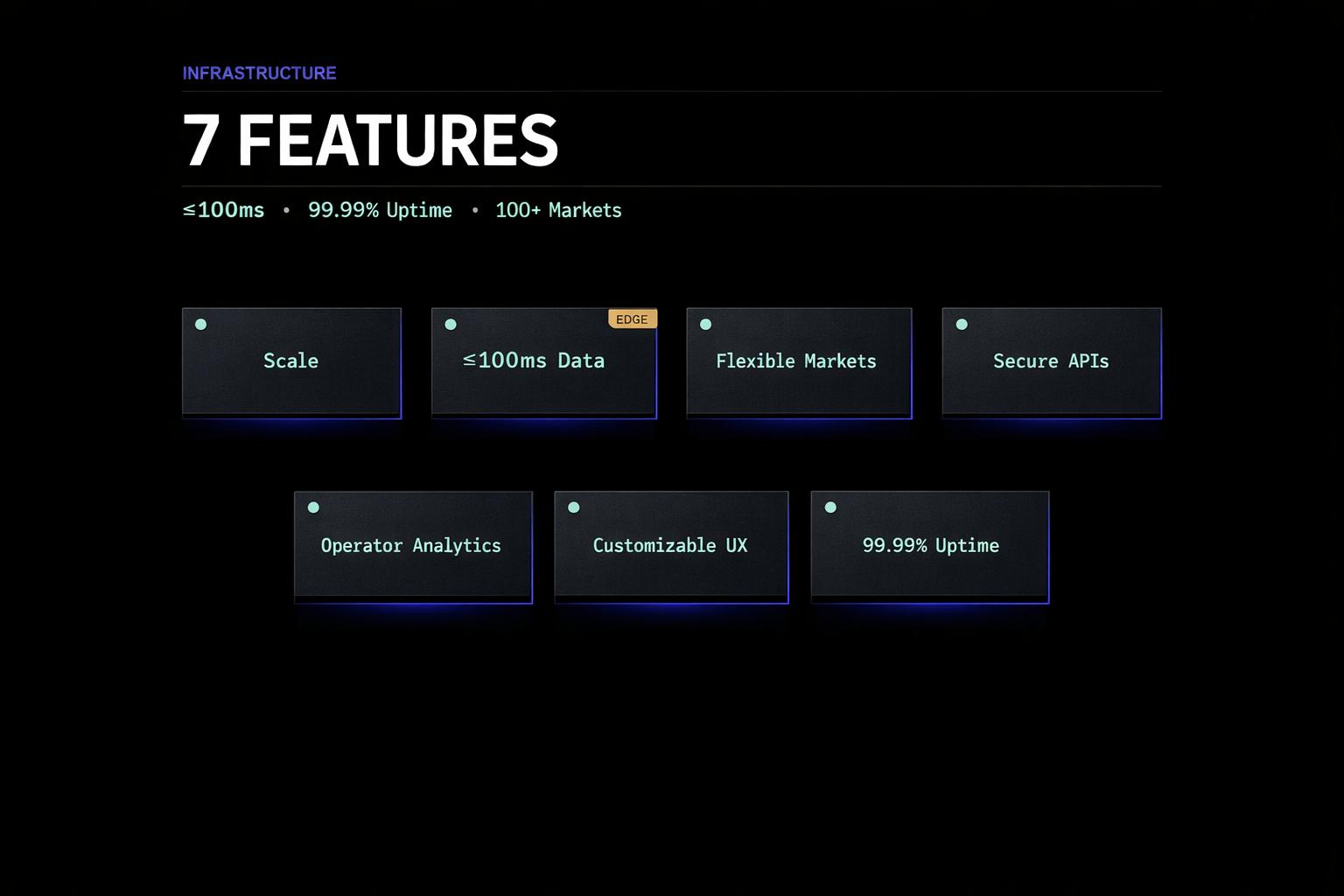
When choosing a betting infrastructure platform, operators need to focus on features that ensure performance, scalability, and compliance. Here's a quick breakdown of the seven key features that matter most:
- Scalability and High Availability: Handle traffic spikes during major events (e.g., 15,000 transactions/sec during the 2024 Super Bowl) with cloud-native, microservices-based platforms that ensure 99.99% uptime and low latency.
- Real-Time Data Processing: Support in-play betting (70%+ of sportsbook handle) with sub-100ms latency for odds updates and fail-safe data redundancy.
- Flexible Market Configuration: Quickly launch or adjust markets using no-code dashboards and tools for dynamic product management.
- Integration and APIs: API-first design ensures seamless connections with payment processors, data providers, and compliance tools, reducing development time.
- Security and Compliance: Meet U.S. regulations with geolocation checks, GLI certifications, and robust risk controls to prevent fraud or system breaches.
- Operator Tools and Analytics: Use dashboards and automated monitoring to track key metrics like weekly active traders and dispute rates while spotting suspicious activity.
- User Experience Customization: Deliver branded, user-friendly interfaces with flexible theming and real-time feature toggles that align with regulatory requirements.
These features ensure platforms can handle high demand, process data efficiently, and remain compliant across jurisdictions.
7 Key Features of a Betting Infrastructure Platform: Performance Benchmarks & Capabilities
Ep. 194: Building skill-based wagering infrastructure w/ Noah Fulk from EWagers
sbb-itb-6d6afac
1. Scalability and High Availability
Betting traffic can be wildly unpredictable. Major sporting events often cause activity levels to spike 10–20 times higher than usual. For instance, during the 2024 Super Bowl weekend, peak activity hit an incredible 15,000 transactions per second. A system that performs well during quieter times might crumble under such pressure.
The architecture of a platform plays a critical role in handling these fluctuations. Traditional monolithic systems require the entire application to scale as one unit, which can be costly, inefficient, and prone to failure during high-demand periods. On the other hand, cloud-native platforms built on microservices allow specific components - like bet placement or wallet services - to scale independently. This means that a surge in live betting activity won’t bring the entire system to a halt. As SmartBet explains:
"Modern sportsbook scalability is not about handling more bets. It is about handling more state transitions."
But scalability alone isn’t enough; the platform also needs to stay operational under heavy loads. Using microservices for independent scaling and deploying active-active multi-region setups ensures 99.99% uptime, even if one data center goes offline. Such setups seamlessly redirect traffic, avoiding disruptions for users placing bets in real time.
High availability is non-negotiable. Tier-1 operators aim for 99.99% uptime, which allows for less than 53 minutes of downtime annually.
Latency is another key factor. Reducing in-play latency by just 100ms can result in a 1.5–2.5% increase in bet acceptance rates. For an operator managing $500 million in annual in-play betting, this improvement could mean an additional $15M–$25M in accepted wagers. Technologies like Protobuf-over-WebSocket help achieve this by shrinking payload sizes by 85–90%, which also reduces CPU usage significantly.
When evaluating platforms, look for evidence of stress testing at 10x–20x normal load, automated horizontal scaling, and clear uptime SLAs. Up next, we’ll dive into how platforms manage real-time data to meet the demands of live betting.
2. Real-Time Data Processing and Market Feeds
Live betting now accounts for over 70% of total sportsbook handle in established markets. This makes your platform's ability to process and deliver data in real time absolutely critical for driving revenue. Consider this: a single NFL game can generate more than 50,000 price updates throughout its duration. To keep up, a Tier-1 odds engine must reprice an entire match - spanning over 200 markets - in under 50ms after any major event occurs. Let’s break down the architecture that makes this speed possible.
The Backbone of Real-Time Data Processing
The secret to lightning-fast data processing lies in the system's architecture. Most modern platforms rely on an event-driven backbone - often powered by tools like Apache Kafka or Pulsar. These systems ingest massive data streams from providers such as Sportradar or Genius Sports, normalize the data into a consistent format, and send updates to users via persistent WebSocket connections. This setup can handle over 40,000 updates per second, achieving end-to-end latency as low as 30–80ms. Compare that to older REST polling systems, which often lag behind with latencies ranging from 800 to 2,000ms.
The Role of Efficient Data Formats
Even the format of your data can have a major impact. Switching from JSON to Protocol Buffers (Protobuf) cuts payload sizes from about 4KB to just 400 bytes per update - a 90% reduction. This not only saves bandwidth but also slashes CPU deserialization time. At scale, this efficiency can be the difference between a system that seamlessly handles 10,000 concurrent events and one that requires costly over-provisioning to stay afloat.
"The operator running a sub-150ms odds pipeline with automated liability management will structurally outperform a competitor processing at 800ms." - Spill.media
Mitigating Risks with Redundancy
Relying on a single data provider is risky. If that feed fails during a major event, your markets could go dark. To avoid this, Tier-1 operators build an aggregation layer that monitors multiple providers simultaneously and triggers automated failovers in under 50ms. For US-regulated markets, you’ll also need to account for 50–150ms of geolocation verification time (e.g., GeoComply). This verification must fit within your total latency budget - not be tacked on as an extra delay.
Latency Benchmarks for Competitive Performance
To deliver a competitive real-time odds pipeline, here are the key latency targets for each component:
| Component | Latency |
|---|---|
| Data Provider Feed (Pitch to Ingestion) | 50–150ms |
| Odds Engine Repricing | 20–50ms |
| WebSocket Fan-out to Client | 30–100ms |
| Bet Request Processing & Risk Evaluation | 20–50ms |
| Bet Confirmation Response | 10–30ms |
| Total End-to-End | < 500ms |
Source: Spill.media
These benchmarks highlight the precision and speed required to stay ahead in the fast-paced world of live betting.
3. Flexible Market and Product Configuration
Handling large volumes and fast-paced operations is just one part of the equation. A platform also needs to adapt quickly to shifting market demands. The ability to configure markets rapidly means little if it can’t respond to new betting trends. Operators need the tools to launch markets, refine rules, and adjust to real-world events - all without relying on external teams. This flexibility is what separates a good platform from a great one.
Top-tier platforms offer no-code dashboards, enabling non-technical staff to create markets, set fee structures, and make adjustments in real time. For example, a trader workstation allows manual pricing changes on the fly - whether it’s tweaking stake limits or updating odds during unexpected events.
A unified interface is crucial for managing various market types, including binary, multi-outcome, range-based, and micro-markets. Features like Bet Builders (same-game parlays) and cash-out options add another layer of complexity, requiring real-time re-pricing that accounts for correlated probabilities. With in-play betting leading the charge, efficient management of these dynamic markets is a direct revenue driver. In-play markets typically deliver a margin of 8–12%, compared to just 4–7% for pre-match odds. Clearly, the ability to handle these markets effectively can significantly impact profitability.
"The differentiator in 2026 is in-play and second-screen, not pre-match odds." - Fora Soft
Regulatory flexibility is just as important. Operators venturing into new U.S. states or international markets need built-in tools to ensure compliance. Platforms should automatically filter and display only the markets allowed under local licenses, eliminating the need to rebuild infrastructure for each region. A dynamic rule engine also makes life easier, letting teams update odds margins, stake limits, and bonus structures directly from a dashboard - no coding required.
4. Integration Connectivity and APIs
Connecting seamlessly to external systems is essential for any betting platform. These connections span payment processors, odds data providers, KYC services, CRM tools, and beyond. The speed, reliability, and ease of setting up these integrations directly impact how quickly you can launch and how efficiently your platform operates. Strong connectivity ensures smoother workflows and quicker adaptability to market demands.
A clear, API-first design is the backbone of effective integration. Look for platforms built using RESTful APIs compliant with OpenAPI 3.0 standards, WebSocket streaming for live data, and SDKs supporting multiple programming languages like Python, TypeScript, and Java. WebSockets are particularly important for live betting, as they provide updates in under 10 milliseconds - something REST polling simply can't achieve. For comparison, XO Markets reports a median order execution latency of under 50 milliseconds.
"A sportsbook is only as strong as its API infrastructure." - Altenar
Aggregator-style connectors simplify the process by combining data from multiple providers into a single, unified interface. This eliminates the need to maintain multiple fragile integrations, each with unique authentication protocols, data models, and rate limits. By doing so, development time is significantly reduced. For example, Interexy estimates that a full trading integration using a unified SDK can take just 1.5 to 2 months, while a data-only display integration may be done in as little as 2 to 4 weeks. These streamlined integrations not only speed up deployment but also enhance the platform's scalability and real-time performance - key features discussed earlier.
"Building and maintaining direct integrations with every exchange is expensive and fragile - each has its own API, data format, and rate limits." - OpticOdds Developer Documentation
Security is another critical aspect of robust integrations. Features like idempotency keys help prevent issues like duplicate bets or double-billing during network timeouts - an absolute must for any financial transaction. Other essential measures include HMAC-SHA256 authentication, mandatory HTTPS, and append-only audit logs, which should be retained for up to seven years to meet compliance standards. Before going live, always request access to a sandbox or UAT environment. Testing API responses in a controlled environment ensures smooth operations and minimizes potential issues.
5. Security, Compliance, and Risk Controls
When it comes to betting platforms, security isn’t just a feature - it’s a necessity. As Fora Soft aptly puts it, "A sportsbook is five financial-grade systems pretending to be one." In other words, every component of your platform - market-making, payments, identity verification, audit reporting, and the user interface - needs to be fortified with multiple layers of protection.
Key Security Measures
To safeguard the platform, implement industry-standard practices like SSL/TLS encryption, Role-Based Access Control (RBAC), and active defenses such as DDoS mitigation and managed firewalls. Security should also be woven into the development process. This means using automated tools like SAST/DAST, conducting peer reviews for high-risk services (e.g., wallets and KYC systems), and maintaining strict separation between production and development environments.
"Regulators now expect you to demonstrate engineered security, not just best efforts or ad‑hoc heroics." - ISMS.online
Navigating U.S. Compliance
Operating in the U.S. means dealing with a complex web of regulations. For instance, prediction markets fall under the oversight of the Commodity Futures Trading Commission (CFTC). Securing a Designated Contract Market designation requires meeting stringent regulatory standards and adhering to state-specific rules.
Platforms must also use geolocation services, like GeoComply, to ensure bets are placed within licensed state boundaries. This comes at a cost - typically $0.05–$0.20 per check. Additionally, achieving GLI-19/33 technical certification is essential. This process can take 6–14 weeks and cost anywhere from $40,000 to $120,000.
Risk Controls That Matter
To manage risks effectively, adopt a dual-phase surveillance strategy. Pre-trade controls should block restricted individuals from placing bets, while post-trade forensic analysis can help detect any signs of market manipulation. Real-time liability monitoring is another critical aspect, enabling immediate price adjustments or even market suspensions when necessary. And don’t forget to log all trading activity with sub-second precision, keeping records for at least five years.
6. Operator Tools, Analytics, and Monitoring
Managing a platform effectively goes beyond just scalability and security; it requires robust tools, insightful analytics, and constant monitoring. Operator dashboards play a crucial role by offering instant insights into market trends, order book depth, and the status of instruments (e.g., Open, Suspended, Halted, Closed). To track performance and ensure smooth operations, focus on three key metrics:
- Weekly Active Traders (WAT): A primary indicator of growth.
- Median Trade Size: Reflects user confidence.
- Resolution Dispute Rate: Measures trust and efficiency. According to the Kuest Operator Cohort Study, a healthy rate is below 0.3%, while anything above 0.5% signals serious issues.
"WAT growth, sustained, compounds into volume; WAT decline is the leading indicator of operational problems that will manifest in volume metrics within a month." - Kuest
Regular and structured reviews amplify the impact of these metrics. For instance, daily tracking of WAT and trade volume, weekly cohort retention checks, and monthly reviews of fee revenue and audience growth can drive significant improvements. In fact, active, data-driven management has been shown to multiply volume by up to 4x.
| Frequency | Key Metrics to Track |
|---|---|
| Daily | WAT, trades, volume, deposits, withdrawals, support tickets |
| Weekly | Cohort retention, market‑by‑market volume, dispute summary, fee revenue |
| Monthly | Content performance, audience growth, strategic review, regulatory submissions |
| Quarterly | Competitive positioning, vertical expansion, fee evolution, board‑level review |
Automated monitoring is another critical component. Tools like automated outlier alerts for unusual price movements, AI-powered trade surveillance to spot manipulation, and sentiment tracking on platforms like Reddit and X provide real-time oversight. Additionally, support ticket volume serves as a reliable indicator of platform health. Ideally, there should be fewer than 5 support tickets per 100 weekly active traders. Exceeding this threshold often points to deeper operational challenges.
7. User Experience Customization and Front-End Flexibility
While a strong back end is critical, the front end plays an equally important role in creating a seamless and personalized betting experience. For U.S. operators, delivering a native, branded interface is key. Here's how combining white-label flexibility with configuration-driven theming can transform the user experience.
One effective strategy is to leverage modern frameworks that allow multiple operator brands to run from a single codebase - completely eliminating the need for conditional code per client. With this setup, operators can craft unique interfaces by modifying JSON configuration files. These files control everything from themes and layouts to specific features. By using CSS Custom Properties and a centralized ClientConfig.json, operators can easily manage brand colors, feature toggles, and layout parameters. Additionally, Module Federation lets teams deploy core components - like the sportsbook, bet builder, or user account sections - independently, without rebuilding the entire platform.
For operators still waiting on full API integration, embeddable front-end widgets can serve as a temporary solution. These widgets ensure a consistent user experience across mobile, desktop, and tablet platforms.
| Customization Layer | Method | What It Controls |
|---|---|---|
| Brand Identity | CSS Custom Properties | Colors, fonts, spacing - no code changes needed |
| Feature Toggles | JSON ClientConfig | Enable/disable features like casino or e-sports |
| Layout Adjustments | JSON ClientConfig | Modify elements like border radius or sidebar width |
| Market Selection | Adapter-level Filters | Determine which event categories users can access |
| New Product Entry | API or iframe Modules | Add features like prediction markets or bet builders |
Regulatory compliance is another critical consideration for user interfaces. For instance, prediction market contracts must be labeled as "trades" instead of "bets" to align with CFTC regulations. This highlights that front-end flexibility isn't just about branding - it also plays a crucial role in meeting legal requirements while enhancing user engagement.
Comparison Table
Each feature plays a critical role in shaping platform performance. The table below offers a quick overview, showing how each feature contributes to operational efficiency, measurable outcomes, and how OpenMarkets delivers on these needs. Use this as a handy reference when assessing what matters most for your business.
| Feature | What It Does | Why It Matters | OpenMarkets Capability |
|---|---|---|---|
| Scalability & High Availability | Handles high traffic spikes without downtime | Prevents revenue loss during busy periods; top operators aim for 99.99% feed uptime | Cloud-based infrastructure managing over $1B in yearly traded value |
| Real-Time Data Processing | Provides sub-100ms odds and market updates | Faster updates mean a 1.5–2.5% boost in bet acceptance rates for every 100ms saved | Real-time streaming of market data, live quotes, and market depth via FIX and REST APIs |
| Flexible Market Configuration | Supports quick market and pricing changes | Helps operators adjust margins and stay competitive during volatile events | Access to equities, options, ETFs, and advanced order types (e.g., stop-loss, OCA) across ASX, Cboe, and NSX |
| Integration Connectivity & APIs | Links to external feeds, tools, and systems | Ensures multi-feed aggregation with sub-50ms failover for uninterrupted data | API-first design with REST endpoints, FIX protocol, and a UAT sandbox for pre-launch testing |
| Security, Compliance & Risk Controls | Safeguards data and automates risk decisions | Risk engines must act within 30ms to avoid blocking the bet pipeline | ISO 27001:2022 certified; real-time risk management, margin engine, and stress-testing tools |
| Operator Tools & Analytics | Tracks exposure, transactions, and user behavior in real time | Helps traders detect and stop suspicious activity before liabilities grow | Back Office Data API with real-time cash monitoring, broker reporting, and detailed customer insights |
| UX Customization | Creates tailored, frictionless front-end designs | Boosts user retention by offering a seamless, branded experience | Full white-labeling of terminals, contract notes, and reports; customizable dashboards with 90+ technical indicators |
This breakdown highlights how technical excellence drives revenue, compliance ensures smoother operations, and user experience customization keeps engagement high.
"Sportsbook profitability is an infrastructure problem, not a content problem." - Spill.media Intelligence
Let this table serve as a checklist when evaluating platforms. These insights provide a framework for understanding how each feature contributes to a platform's overall success.
Conclusion
Picking the right betting platform is a big decision for any business. The seven key features discussed - scalability, real-time data processing, flexible market configuration, API connectivity, security and compliance, operator analytics, and UX customization - lay the groundwork for a platform that can endure and thrive. For operators in the U.S., these features are especially important due to the complexities of state regulations.
In the U.S., the challenges are even greater. Navigating state licensing, geolocation requirements, and stringent reporting demands makes compliance a core part of the operation. Platforms that lack automation tailored to state-specific rules or integrations like GeoComply face immediate regulatory challenges. As Lior Yashinski, Co-Founder of Track360, explains:
"The affiliate management module is where sportsbook management software decisions made at launch create operational debt that compounds as the partner program grows."
The choices made during the initial setup - whether it’s about risk controls, API design, or the flexibility of the user interface - will either streamline operations or lead to ongoing complications. With mobile devices driving 80%–90% of online betting activity and live betting making up more than 50% of total wagers, there’s no room for platforms that can’t keep up with these demands.
FAQs
What uptime and latency numbers should I require in an SLA?
When choosing a dependable betting platform, it's essential to set clear performance benchmarks. Here's what to focus on:
- Uptime: Aim for a Service Level Agreement (SLA) guaranteeing 99.9% to 99.99% uptime. This ensures downtime stays below nine hours per year, keeping the platform consistently available.
-
Latency Standards:
- Odds delivery should occur in under 200ms.
- Bet requests must be processed within 50ms to ensure a smooth user experience.
- WebSocket Performance: Keep WebSocket fan-out latency under 100ms. This helps maintain competitive response times and minimizes bet rejections.
These metrics are critical for ensuring a fast, reliable, and user-friendly betting experience.
How can I verify a platform’s real-time odds pipeline is truly low-latency?
To maintain low latency, measure the end-to-end delay from when the odds engine generates a price to when clients receive it. The goal is to keep this delay under 100 milliseconds. Use synchronized timestamps - like those from NTP (Network Time Protocol) or PTP (Precision Time Protocol) - to calculate delays accurately. This helps detect stale or out-of-order updates.
For transport, rely on WebSockets instead of REST polling. WebSockets ensure that odds changes are pushed to clients instantly, avoiding delays caused by periodic polling. Finally, stress-test the system under peak traffic conditions to ensure it meets service-level objectives (SLOs) and supports consistent monitoring.
What compliance controls are must-haves for launching in multiple U.S. states?
To operate across multiple U.S. states, your platform needs a state configuration layer that can adapt to jurisdiction-specific regulations. Here are the key compliance controls to focus on:
- Identity and AML: Ensure proper age verification, Know Your Customer (KYC) processes, and sanctions screening to meet regulatory standards.
- Geo-verification: Implement real-time tools to enforce state boundaries with accuracy under 200 meters.
- Responsible Gambling: Provide features like deposit limits and self-exclusion options to promote safe gambling practices.
- Reporting: Maintain centralized, state-specific reports along with immutable audit logs to meet auditing requirements.
- Offering Compliance: Use automated systems to ensure all content aligns with state-approved guidelines.
Each of these controls is crucial for maintaining compliance and ensuring smooth operations across jurisdictions.